Why Do “Entry Level Jobs” Ask for 3 Years of Experience?
Learn why employers do it, and how to get hired without it.
You are about to enter the job world. Maybe you are a recent graduate seeking your first job, or you are changing careers and starting from scratch. The next obvious step is to look for an entry level job. So you open an online job board and type in entry level jobs. Voilà, a list of job ads comes up. You see one that seems like a good fit. Something that could easily launch your career in the right direction, but here comes the kicker. The requirements section states, “3 years of experience required”.
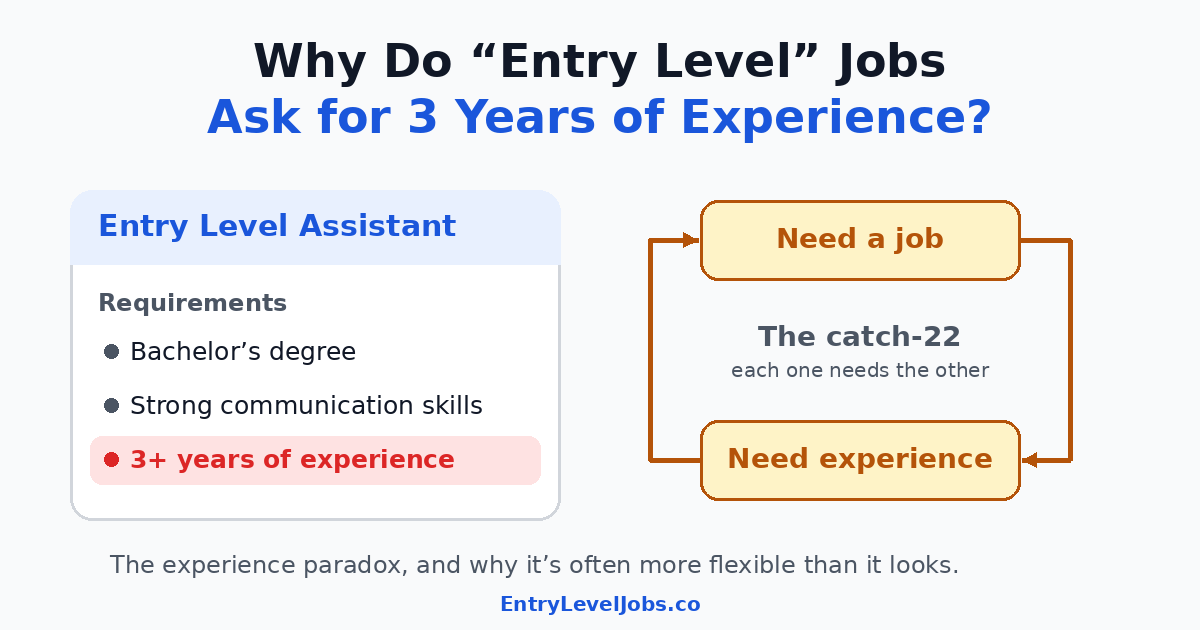
Suddenly nothing makes sense. How is this possible? An entry level job that requires experience sounds like a cruel joke, yet research shows that roughly a third of jobs listed as “entry level” now require 3 or more years of experience. How can a job be entry level when it demands experience that you cannot get without already having a job?
This is a frustrating paradox many graduates and career changers experience today and has led to many LinkedIn posts and Reddit threads trying to understand how you are expected to meet the experience requirement demanded by job ads today when you are looking for your first job.
What does this mean for the new job-seeker who lacks the experience needed to even be considered for an entry level job? Do you stop applying for jobs that would be a good fit for you simply because you do not have the relevant experience? Simple answer: “No.”
The surprising thing is, most employers will still consider you even if you do not tick the experience requirement box. In fact, a Robert Half survey found that most HR leaders would still consider hiring and training a candidate who lacks required skills. So, why would employers post “entry level jobs that require experience” when they are open to hiring a person who does not even meet these requirements? Here are a few reasons:
Some Job Ads are Wish Lists, Rather Than Non-Negotiable Requirements
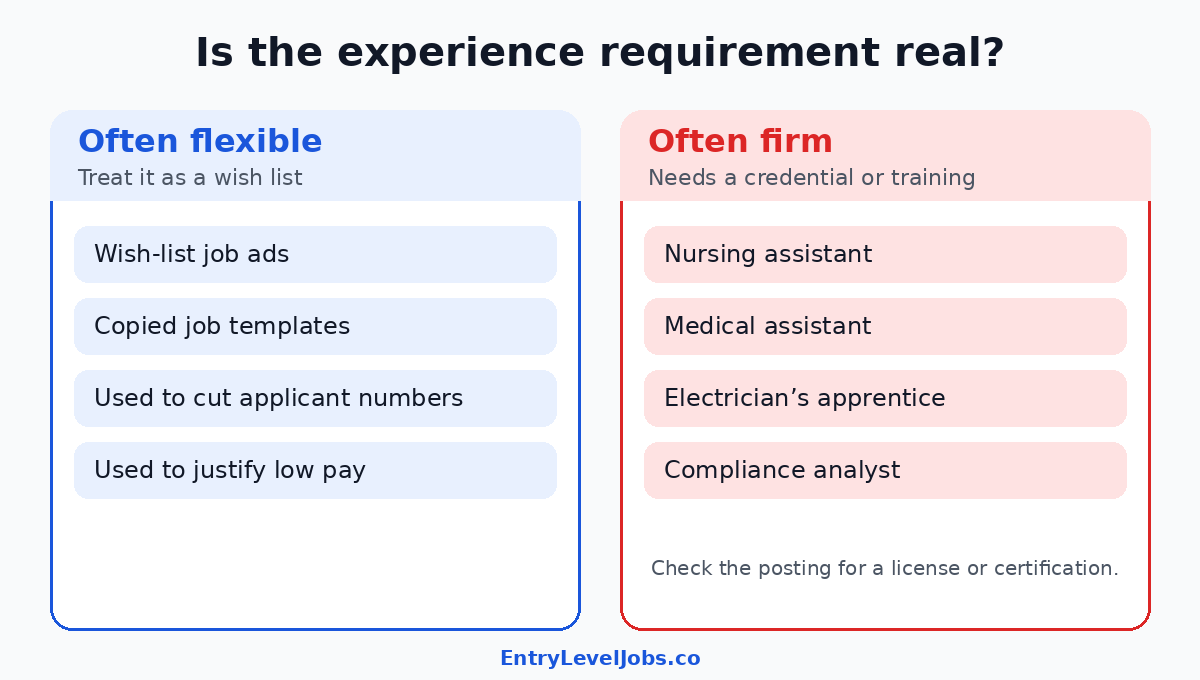
A lot of the job posts and ads we see are posted by recruiters. Recruiters are looking for the perfect candidate to do the job. Hence, they post aspirational requirements they wish their candidates could have. However, what they fail to mention is that some of these required qualifications are more desired than required. It’s a wish list rather than hard rules set in stone. This means that just because you do not meet all the listed requirements does not necessarily mean the company will reject your application.
Sometimes, the recruiter writes job ads based on the person they would dream of hiring rather than the person they actually need. They borrow their listed qualifications from previous templates, automated systems, or even mid-level job descriptions without actually checking whether the qualifications apply. Consequently, you end up with an entry level job ad that demands 3 years’ experience and a set of skills most job-seekers cannot match.
However, you should not let the years of experience suggested discourage you from applying. Most recruiters and hiring managers do not expect candidates to check all the boxes. Candidates who don’t have all the years required still have a big chance of being considered if they show they have the right skills and mindset.
Entry Level Jobs Requiring Experience Is an Easy Filtering Tool
Online job boards and automation have made it so easy for as many people as possible to apply for different jobs. On average, a single job posting can receive hundreds of applications. This number is often even higher for entry level roles, and recruiters need to whittle down these numbers to a handful of candidates who will be invited to interview.
When looking at these staggering numbers, listing “entry level jobs that require experience” becomes an easy way for hiring managers to narrow down the pool quickly and efficiently. It is simply impossible to interview everyone, which is why more entry level jobs are coming with the 3 years’ experience tag.
Entry Level Jobs That Aren’t Really Entry Level
Not all jobs listed as entry level are actually entry level. In some cases, it’s a way for companies to justify paying less. It is an easy assumption that if you get an entry level job, then you can expect entry level pay. As a result, you will find a company offering an entry level position with the pay to match that level, yet it requires much more than what is typically expected of an entry level employee. Some companies use the term entry level to justify the low pay they are offering.
So entry level jobs that require experience and an extraordinary set of skills that are unrealistic for a beginner could just be the company’s way of budgeting.
When Entry Level Jobs Requiring Experience Really Matters
Although some experience requirements are flexible, it would be misleading to claim that they all follow this route. Certain positions do require some experience or credentials even at a beginner level. Think of a nursing assistant, a medical assistant, an electrician’s apprentice, or a compliance analyst. These jobs often ask for a certification, a license, or some supervised practice before you can start. They ask for it because mistakes can have serious consequences and sometimes put other people’s safety at risk. So in jobs like these, the requirement is real, not just something a recruiter would like to see.
What Does This Mean for You?
Now that you understand why entry level jobs requiring experience are a thing, you can shift your job-hunting strategy towards success. Seeing three years’ experience listed under an entry level position should not automatically tell you that you do not qualify for the job. One thing you need to remember is that we usually have more qualifying experience than we think. Framing projects, coursework, internships, and volunteering as relevant experience is an excellent way to showcase transferable skills and show proof of capability to recruiters. Tailoring your resume to match relevant keywords in a specific job description is also a great way to ensure you do not get lost in the high volume of applicants. More companies are using ATS now to filter applications. Crafting a more relevant resume fit for the specific job description is just a smart way to increase your chances of making the cut.
Also, do not underestimate the power of a cover letter. In most job applications, submitting a cover letter is optional, but for an applicant with no experience, this is an opportunity you should not miss. Cover letters allow you to tell a more vivid story about your strengths, your experience gap, and why you are the best fit. They are an opportunity you should always take advantage of. Successfully applying for a job is all about strategy. Remember, experience is a nice tool to have on your resume, but a lack of it is not the job application killer you think it is for entry level jobs. Write a killer application, take your shot, and see what happens.
Plus, you can easily find job opportunities right here on entryleveljobs.co that are perfect for new graduates and career changers. Just look up entry level jobs without experience, and find the perfect fit for you today.
Related reading
- Why the Best Candidate Doesn’t Always Get the Job
- How to Get an Entry Level Job With No Experience
- Do I need experience to apply to these jobs? in our FAQ
References
- Anders, G. (2026, April 10). Hiring’s new red line: Why newcomers can’t land 35% of “entry-level” jobs. LinkedIn. https://www.linkedin.com/pulse/hirings-new-red-line-why-newcomers-cant-land-35-jobs-george-anders/
- Brothwell, P. 2026 job application statistics. HiringThing. https://www.hiringthing.com/blog/job-application-statistics
- Robert Half. (2019, March 19). Survey: 42 percent of job applicants don’t meet skills requirements, but companies are willing to train up. Robert Half Press. https://press.roberthalf.com/2019-03-19-Survey-42-Percent-Of-Job-Applicants-Dont-Meet-Skills-Requirements-But-Companies-Are-Willing-To-Train-Up
- Paterson, K. (2025, July 30). Shocking entry-level job experience paradox: Why 35% of entry-level jobs now require 3+ years experience. WhatJobs News. https://www.whatjobs.com/news/shocking-entry-level-job-experience-paradox-why-35-of-entry-level-jobs-now-require-3-years-experience/