Why the Best Candidate Doesn’t Always Get the Job
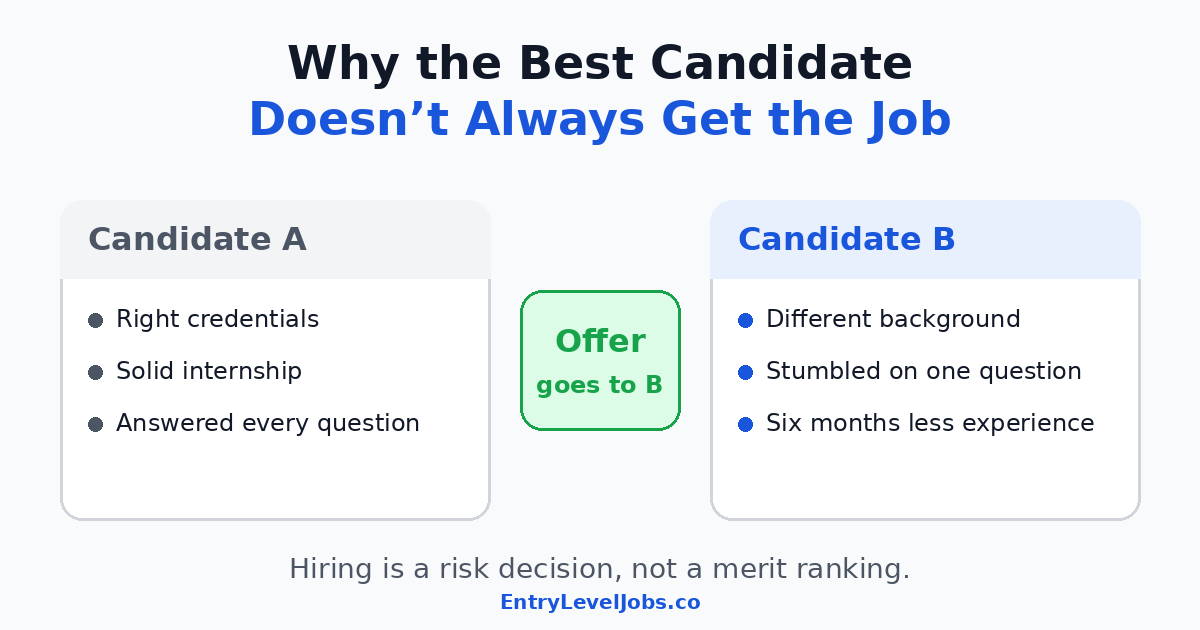
Two candidates make it through a four-round interview process.
A has the right credentials, has done an internship at a decent company and answers every question without any issues. B is from a completely different background, gets stuck on a behavioral question and has six months less experience. All things considered, it’s a no-brainer.
B gets the offer call on Friday afternoon. A gets a three-sentence email from the employer: “Thanks for your time, well done on the interview and all the best in your search.”
If you’ve ever walked out of an interview thinking you’d absolutely nailed it, only to get a rejection a week later, you’ll know what happens. You go over every answer, the joke that fell a bit flat, the follow-up question you could have asked. You end up sitting in front of a screen wondering why you didn’t get the job. The truth is it’s almost never down to you not being good enough.
Hiring is a risk decision rather than a merit ranking. Companies don’t operate as if they’re judges with scorecards and gold medals for the most qualified person in the room. The hiring manager is in effect a risk-averse investor trying to avoid making a costly and painful mistake.
1. Employers Often Choose the Safer Candidate, Not the Strongest
To get a proper understanding of how an offer actually gets approved, you have to put yourself in the shoes of the person who is going to be the one to sign off on the hire. When a manager brings someone on board they’re not just ticking a box on a spreadsheet. They’re putting their own reputation and their own working environment at risk.
SHRM points out that hiring and onboarding can be very expensive. One of their articles quotes an industry expert’s estimate that recruiting, hiring and onboarding an employee can run well into six figures at the high end. A figure that often comes up in the hiring world is that a bad hire can cost a large share of that person’s first-year salary.
When the cost of a bad hire is high then you have a strong incentive to be risk averse.
In practice, risk aversion means that a hiring manager may go with the safe, predictable, reliable, easy-to-manage candidate rather than the high-ceiling standout. The high-ceiling standout is the one that actually triggers the doubts. The manager will think “That person will get bored with the job in four months, they’ll want a promotion before the department budget allows it and they’ll go when a bigger company comes along and offers them more money.” The safe candidate isn’t necessarily the more capable one. They’re just seen as the lower risk.
2. “Culture Fit” and the Invisible Pull of Interviewer Bias
When companies are explaining why one candidate has been selected over another they will invariably revert to the term “culture fit”. It’s obviously important to get on with your colleagues. “Culture fit” can, however, also be a gateway to unconscious bias in the selection process.
Organizational psychologists have looked at how fast people form impressions of one another. In their work on “thin slices” of behavior they found that very brief observations (sometimes less than 30 seconds) could be used to predict certain outcomes. It does show that first impressions can be formed very quickly indeed; it doesn’t prove that the interviewer is making a decision before the first question is asked. In an interview, you can quite easily have a gut feeling before the first question is even asked.
Another factor is affinity bias (also known as similarity attraction bias). As described in a Harvard Business Review article, “How to Reduce Personal Bias When Hiring,” interviewers will tend to favor candidates who are similar to themselves. A candidate (Finalist B in this case) who grew up in the same town as the team lead would be a perfect example of this. One comment can be enough to trigger the affinity bias, and the candidate has effectively won. Affinity bias is not in any way a function of competence and is purely a matter of psychology in a conversation.
3. Speed Wins: Why Timing Beats Perfection
Job seekers will often imagine that at the end of the month the hiring team will be sitting around a conference table with all the resumes of the finalists in front of them and doing a proper side-by-side comparison. That doesn’t always happen.
Lots of companies won’t open a job requisition until they’re already under pressure. The work just piles up, the team gets burned out and the hiring manager is under real pressure. In that situation the manager may well just go with the first person who meets their needs well enough. That’s what the behavioral economists call satisficing. The term was coined by Nobel Prize winner Herbert Simon to describe the process of choosing an option which is satisfactory or “good enough” rather than going on searching forever for the absolutely best option. Simon’s Nobel lecture explains the concept.
Think about what that means for your timeline. If you’ve got a really strong, likeable candidate in for an interview on Tuesday and they appear to be the right person, the team may well be committed to that candidate before you’ve even got on the Zoom call on Thursday. By the time you’re on that call you’re not competing on an even playing field. You’re trying to persuade them to go back on a decision they may have already made.
4. The Hidden Factors You Never See
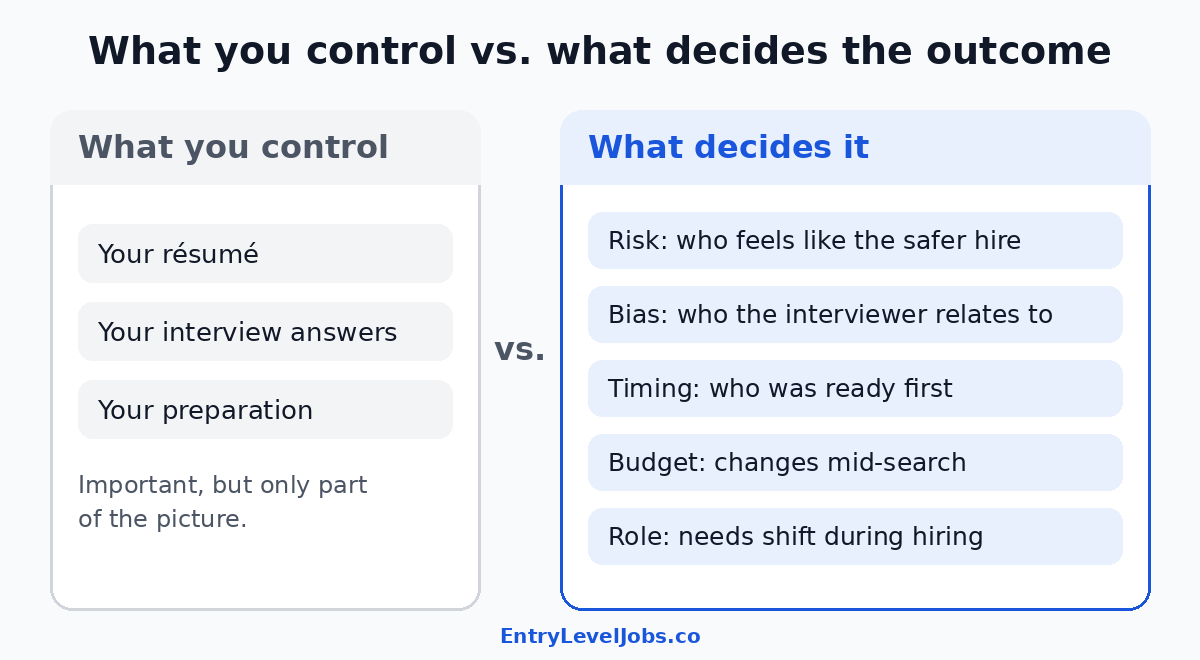
Perhaps the hardest thing about job hunting is just coming to terms with how much of the outcome is in the hands of the company behind closed doors, irrespective of what you’ve said or what you’ve done. If you’re actively job hunting for an entry level position and you’re applying for jobs that look like a perfect fit for your experience, the company’s situation can change completely overnight and you and the other applicants won’t know.
Consider the variables that can derail finalists:
- An internal move or late referral: a current employee from another department wants to move into the role, or an executive’s former colleague puts in a resume just as the offers are being made.
- A sudden budget squeeze: Finance has revised the forecast partway through the search and the hiring manager is now in a position where they have to pick a candidate who will accept the bottom of the range rather than the top end.
- A change in what the team actually needs: halfway through the interview process leadership realized they didn’t in fact need someone to build systems. They needed someone to maintain the existing spreadsheets. A completely different finalist would now be the ideal candidate.
None of that reality is in the rejection email. You get told absolutely nothing about the internal politics, the budget freezes, and the lack of planning. You’re left with the email and the feeling that you somehow didn’t cut it.
Why Didn’t I Get the Job? What You Can and Can’t Control
You can’t control a department’s budget freeze, an interviewer’s unconscious preference for someone who just happens to be like them or whether another candidate got the interview two days earlier. What you can control is how you interpret the result. A rejection after an interview is not a rejection of you as a person or as a candidate. It’s a rejection of the timing, the risk and the alignment with the department. Keep putting yourself in front of the right rooms. You can browse current entry level openings on EntryLevelJobs.co. Treat every rejection as information rather than as a personal failure. Just let go of the outcomes that were never yours to begin with.
Related reading
- How to Get an Entry Level Job With No Experience
- Why Do “Entry Level Jobs” Ask for 3 Years of Experience?
- Don’t want to keep checking? Create a free email job alert and we’ll send you new matches.
References
- Frye, L. (2017, May 9). The cost of a bad hire can be astronomical. SHRM. https://www.shrm.org/topics-tools/news/employee-relations/cost-bad-hire-can-astronomical
- Tulshyan, R. (2019, June). How to reduce personal bias when hiring. Harvard Business Review. https://hbr.org/2019/06/how-to-reduce-personal-bias-when-hiring
- Ambady, N., & Rosenthal, R. (1992). Thin slices of expressive behavior as predictors of interpersonal consequences: A meta-analysis. Psychological Bulletin, 111(2), 256–274. https://doi.org/10.1037/0033-2909.111.2.256
- Simon, H. A. (1978). Rational decision-making in business organizations (Nobel Prize lecture). NobelPrize.org. https://www.nobelprize.org/prizes/economic-sciences/1978/simon/lecture/