Entry Level Jobs: How Each Company Size Hires Beginners
The same resume can go through three completely different hiring processes. Here’s what you might expect from each kind of employer before you start applying for entry level jobs.
Key Takeaways
- Startup companies typically hire from direct applications and tend to keep the interview-to-hire process short.
- Corporations often run early-career programs and use software that helps recruiters sort applicants by skills and keywords.
- Mid-size companies fall somewhere in between, usually involving a hiring manager to make the interview and hiring decisions.
- Timing varies by company type: many corporate programs recruit in the fall, and startups recruit when positions open or are needed for the next step of growth.
You can send the exact same resume to three different employers and end up experiencing three very different hiring processes.
That’s what makes preparing for one type of job interview a bit more challenging than you might expect.
One company could receive your application and respond within the same week. Another might send you to an application portal and then go quiet.
Job competition is stiff nearly everywhere you look. Indeed’s Hiring Lab found that, in May 2026 alone, 30% of applications sent to entry level postings were sent by workers with 10+ years of experience.
Higher competition and fewer jobs mean you need to know exactly what to expect for the type of job you are looking for and the company you’re applying to.
Startups: Short Process with Higher Expectations
Most startup roles still start with the traditional application. Ashby (which runs automated application software for a variety of companies) ran a study of 1,200 venture-backed startups and found that 42% of hires came from inbound applications, compared with 15% from referrals.
That’s good news if you happen to lack a network that can connect you with an open position. But the cost is how crowded the space is: startups under 25 employees saw about 298 applications per hire.
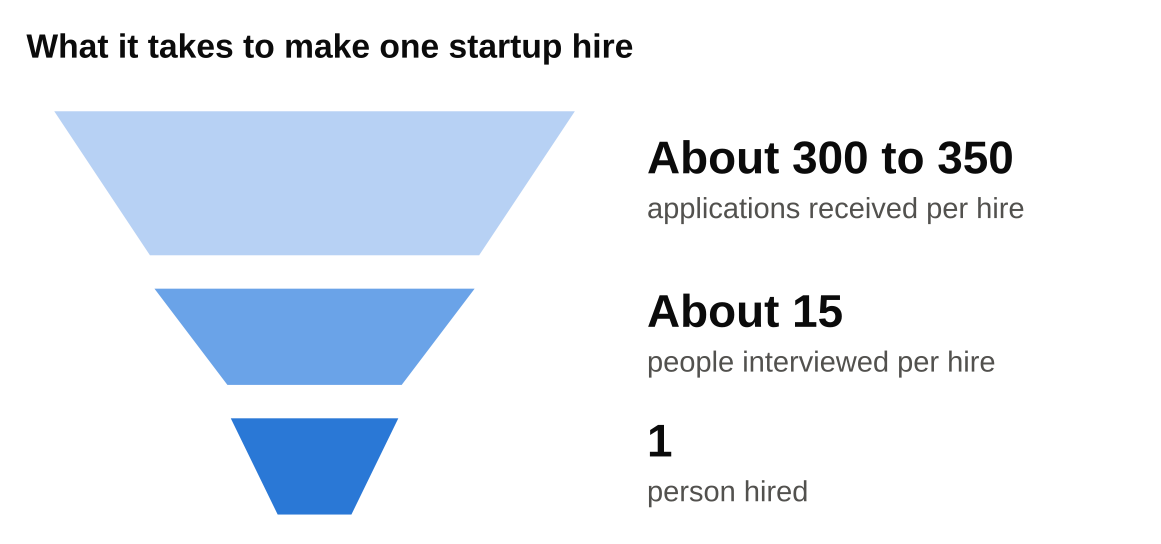
In the application process, most interviews are short (2.5 to 3 hours of interviews total). But the same study found that startups with fewer than 25 employees took 42 days to hire with a recruiter and 62 days without one.
Plus, startups typically lack the formal early-career programs that larger companies may run. That means the application process usually starts with a connection with a founder or manager who has little time to train new hires.
Startups often want to see proof before they hire. What have you built? What can you bring to the table immediately? Do you have a portfolio of those results?
With startups, if the job posting names a person, it may be wise to write directly to them as well as apply through the traditional route (unless they give explicit direction on how to apply).
Mid-Size Companies: Hiring Managers Still Decide
Mid-size companies are those that have roughly 100 to 999 employees. When it comes to application process expectations, they have the least coverage, so take each of these as signals rather than rules.
A study from Robert Half found that 67% of mid-size companies planned to hire entry level positions (those with two or fewer years of experience). A Drexel University outlook found that employers with fewer than 500 employees were about 30% more likely than larger ones to say they won’t hire recent graduates.
Research points to a resource issue: smaller companies often lack the staff and onboarding resources to train and supervise new hires. They often rely on HR teams and managers to recruit alongside their regular work responsibilities, and openings are typically smaller than those at larger companies.
The key to applying to a mid-size company? Match your resume to the exact posting as well as you can, and try to reach out directly to the hiring manager to explain why you would be a great fit for the team (and a quick learner once hired!)
Corporations: Hiring Programs and Pipelines (and Software Sorting)
As you apply, you’ll find that the largest employers (corporations and enterprises) usually have a much more complex and structured hiring process, typically involving more steps before you ever talk to a person.
Jobscan detected that 97.4% of Fortune 500 companies run automated applicant tracking systems (ATS) to manage incoming applications. Many companies are adding AI-powered resume screening tools and one-way video interviews to help filter and manage high volumes of applicants for single roles.
Before you apply, make sure your resume matches the job. An ATS mainly stores and sorts applications, and recruiters often search or filter them by skills or keywords. Tailor your resume to the posting to help it show up in those searches.
It doesn’t hurt to spend a bit of time practicing your video answers with a timer so you’re ready when the interview arrives.
Internships usually feed these hiring pipelines, so it’s always wise to check company career pages for recruiting programs or student-to-hire opportunities.
When Does Each Door Open?
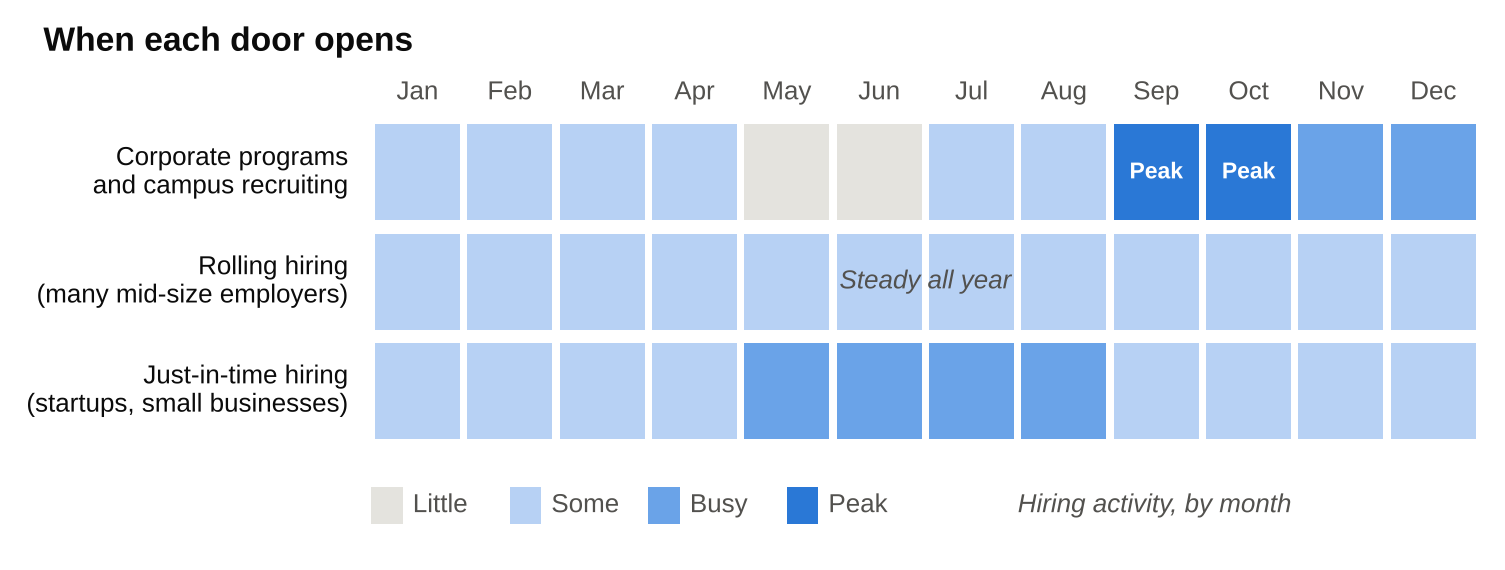
As you apply, keep in mind that different company sizes also run different hiring timelines.
One university career center timeline puts peak recruiting for internships and full-time roles at many larger companies in September to October, with a smaller cycle in January to April.
Startups and smaller businesses are better fits for just-in-time hiring, hiring when openings are needed for specific roles. This requires keeping an eye on hiring pages and networks, so you can apply as soon as possible when a role opens up.
Which Kind of Company Should You Apply to First?
Apply to the kind of company you want to work for, especially if you already have a particular role in mind.
But if you’re willing to apply to any size company, then apply to them all and keep your application tailored to each.
Remember that soft skills (teamwork, problem-solving, communication) are just as important as hard skills, so keep those on your resume and application as they fit the role.
Send a few applications each week, and build a system to track which ones get replies and what you can learn from each interaction.
| Startups | Mid-size companies | Corporations | |
|---|---|---|---|
| Main way in | Direct application to one role | Posted opening, often for one seat | Early-career programs and online applications |
| Process | Short, a few conversations | Hiring manager plus HR | Several stages, software screening |
| What tends to help | Proof of work | Resume matched to the posting | Early application, posting’s own wording |
| Watch out for | A crowded inbound pile | Fewer beginner seats | Software that sorts out applications first |
Want to see what kinds of roles are open right now? You can browse entry level jobs by role and location here, and as you look, note which employers fall into which of the three groups we’ve covered in this guide.
Start Your Search With Openings Built for Beginners
EntryLevelJobs.co gathers the top entry level jobs from employer career pages and job boards into a single free online search that you can browse without an account.
When you find a role that you like, you can follow the link directly through to the employer’s website to apply. Filter for the roles you want to see, and set up an email alert to keep you informed of any new jobs as they are posted.
Related Posts
- Why Do “Entry Level Jobs” Ask for 3 Years of Experience?
- Why the Best Candidate Doesn’t Always Get the Job
- Why do some “entry level” jobs ask for experience? (site FAQ)
References
- Aidala, F. (2026, July 23). Entry-level jobs aren’t just for inexperienced workers. Indeed Hiring Lab.
- ABC4. (2026, January 14). Amid tough jobs market, new college grads seeing fewer openings at small businesses (Drexel University 2026 College Hiring Outlook).
- Ashby. (2026). The state of startup hiring: 2026 talent trends report.
- Business Report. (n.d.). The entry-level squeeze: Small businesses pulling back from hiring new grads.
- Fast Company. (2025, June 20). Employers hiring college graduates cautiously (Drexel University 2025 College Hiring Outlook Report).
- HR Dive. (2024). Robert Half survey on entry-level hiring before the 2024 graduation season.
- Jobscan. (2026, August 20). Fortune 500 use applicant tracking systems (6th edition).
- National Association of Colleges and Employers. (2026). Intern conversion rate hits highest mark in five years.
- National Association of Colleges and Employers. (2026). Skills-based hiring grows but college students don’t fully understand it.
- National Association of Colleges and Employers. (2026). The high-impact skills college students should showcase on their resumes.
- Tempositions. (n.d.). What hiring challenges look like at small, mid-sized, and large companies.
- University of Nebraska-Lincoln Business Career Center. (n.d.). Hiring processes and timelines.